

Introduction:
With the promulgation and implementation of the Outline of the Guangdong-Hong Kong-Macau Greater Bay Area Development Plan, it has become an important consensus to strengthen the protection of intellectual property rights gradually and comprehensively in the Guangdong-Hong Kong, Guangdong-Macau and Pan-Pearl River Delta regional intellectual property cooperation mechanisms in order to optimise the business environment. In order to help companies interested in doing business in Hong Kong, China (hereinafter referred to as "Hong Kong"), to effectively protect their intellectual property rights, this article provides a detailed review of the trademark application registration process in Hong Kong and explains the common problems encountered in the application registration process.
Main Text:
Trademark registration in Hong Kong takes approximately 6 months from application to registration, not including the correction and/or refusal and opposition process. The following is a schematic diagram of the trademark registration application process as published on the website of the Hong Kong Intellectual Property Department.
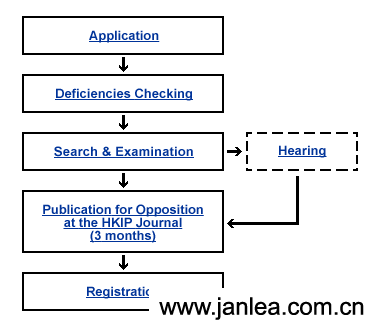
As you can see from the chart above, the trademark application process in Hong Kong, China and Mainland China is basically similar. The following is a detailed introduction to each step of the process and precautions.
I.
To apply to register a trademark in Hong Kong area, you need to complete a Trademark Form T2, which can be mailed or filed electronically.
To file a trademark application, you must provide the applicant's name, address, trademark (JPG format), specified goods/services. Chinese or Roman characters are acceptable, non-Chinese or Roman characters must be transliterated or translated.
If the applicant's name and address are not in Chinese or Roman characters, a translation of the Roman characters is required. US applicants must indicate the state in which the company is incorporated.
Acceptable trademarks include: text, graphics, combined marks, colour marks, 3D stereoscopic marks, sound marks, olfactory marks, dynamic marks, holograms, etc. Trademark samples, if you need to protect the colour of the mark, you must provide colour mark samples. For a series of marks, no more than four; if the mark contains non-Roman or non-Chinese characters, a transliteration or translation of the mark is required. Other unconventional marks, such as colour marks, 3D stereoscopic marks, etc., require specific descriptions.
Goods/services. You can refer to the NICE Classification selection, the official website of the Intellectual Property Department also has a reference description, but the description of goods/services listed on the official website is not complete, therefore it is recommended to refer to the official list of goods and services for your own submission, if the examiner thinks that there is not up to the standard will be issued. Goods/services should be separated by semicolons when completing the T2 form.
About priority. A trademark application may claim the priority of an earlier trademark filed within six months by a member of the Paris Convention or a member of the WTO. Different goods or services can claim different priorities.
If the mark is a collective or certification mark, the relevant rules must be filed within 9 months of the filing date.
If the trademark is a defensive mark, an affidavit or declaration must be filed within 9 months from the filing date. Defensive trademarks are generally applicable to marks with a high degree of recognition in Hong Kong.
II.
At this stage, the main checks are that the application form is complete and correct, and that the attached information is complete. If the application is incomplete or further documentation is required, the applicant should submit the correction within 2 months from the date of notification. At this stage, some problems do not affect the filing date of the trademark, but some cases will affect the filing date of the trademark, such as failure to provide the trademark specimen.
III.
When all the trademark information is complete and in accordance with the rules, the examiner will conduct a substantive examination of the trademark application, that is, the examination of absolute grounds and the examination of relative grounds. Such as: whether the trademark is distinctive; whether the trademark is a trade term, whether there are previous similar trademarks and so on.
IV.
Under the Hong Kong Trademark Rules, if the trademark is refused, the applicant must file a notice of refusal within 6 months. This period may be extended by 3 months. If it is refused on relative grounds, there is a need to negotiate with the owner of the cited trademark, or the cited trademark is invalid and there is a need to await the outcome of the revocation proceedings, etc., it can be extended up to three times, each time by three months. A request for a hearing may be made during the examination period.
V.
After the approval of the trademark examination, the announcement will be arranged, and the announcement period is 3 months. Information about the announcement can be found at https://www.ipd.gov.hk/eng/ip_journal.htm
VI.
After the trademark has been refused, the trademark applicant may either reply or withdraw the trademark application. The opponent is required to file a reply within 3 months of receiving the notification, which may be extended by 2 months. If the applicant does not file a reply or an extension request, the trademark application is deemed to be withdrawn.
If the applicant files a reply, the opponent is required to submit evidence within 6 months of receiving the reply. If the opponent fails to submit evidence within the time limit, the opposition shall be deemed to be withdrawn. The trademark applicant must submit additional evidence in the form of an affidavit within 6 months of the filing of the opposition.
Finally, the applicant must pay the opponent's costs if the trademark is withdrawn or if the opposition is successful.
VII.
Once registered, the trademark is valid for ten years from the date of filing.
 业务领域:
此案件代理人
业务领域:
此案件代理人